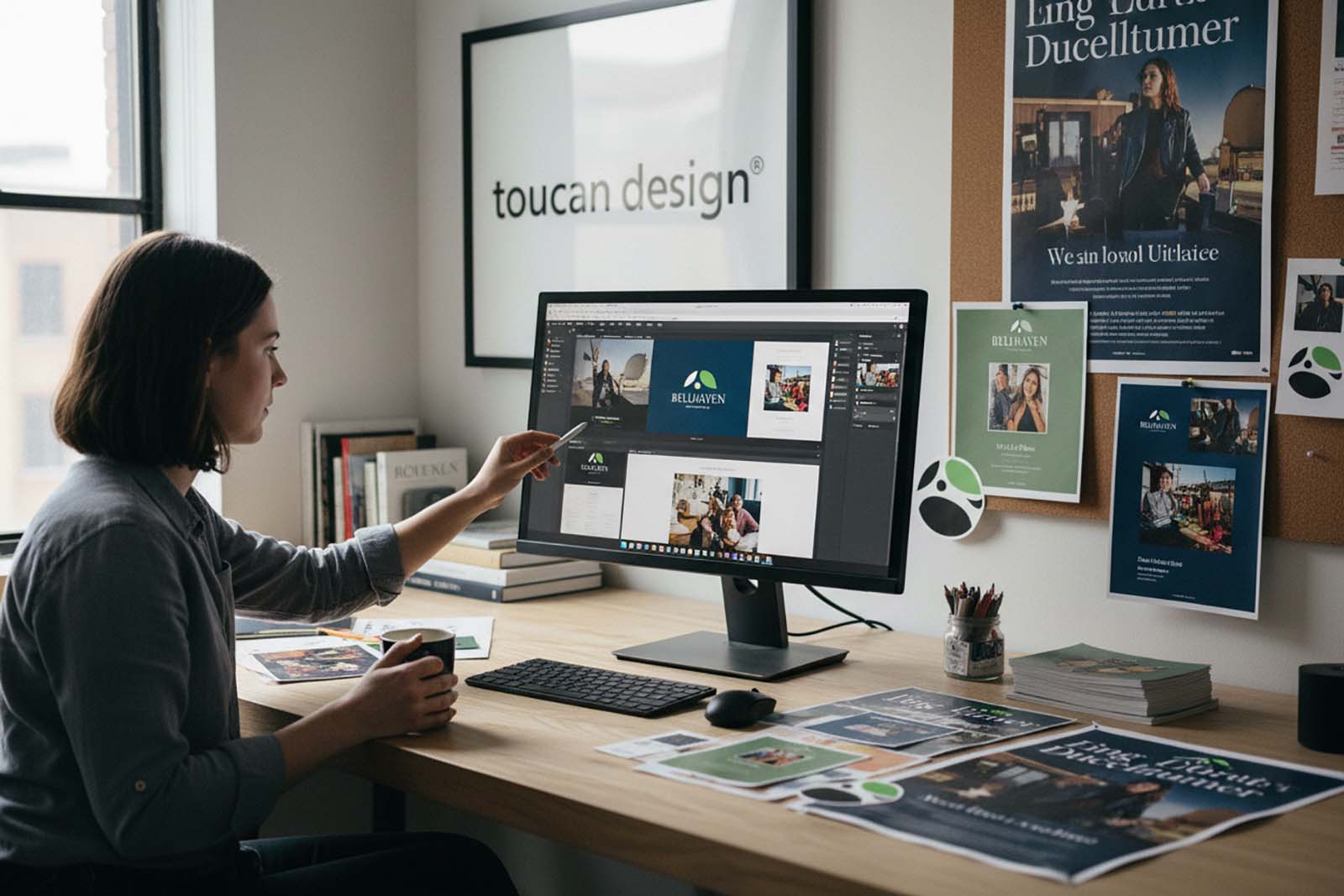
A brochure often gets judged in seconds – on a front desk, in a sales packet, at a trade show, or after a meeting when the conversation is over and your printed piece is left to speak for you. That is why brochure design for business is not just about making something look attractive. It is about presenting your company clearly, professionally, and in a way that supports real business goals.
For many organizations, brochures still play an important role. They help sales teams leave behind something tangible. They give prospects a concise explanation of services. They support events, presentations, direct mail, and in-person meetings. In some industries, they are still one of the most practical ways to explain a complex offering without asking someone to scan a QR code or search for a website later.
The mistake is treating a brochure like a small poster. A good brochure is not a page filled with slogans, stock photography, and cramped text. It has structure. It anticipates questions. It guides the reader from interest to understanding and then toward action.
What brochure design for business should accomplish
A business brochure needs to do three things well. First, it should establish credibility quickly. That means your branding, typography, images, and layout should look consistent and professional. If the piece feels outdated, cluttered, or generic, readers often make assumptions about the business behind it.
Second, it should explain what you do in plain language. Many brochures fail because they try to sound impressive instead of useful. Prospects are usually asking simple questions: What do you offer? Who is it for? Why should I trust you? What makes your approach different? Strong brochure copy answers those questions without making the reader work for it.
Third, it should support a next step. That could mean contacting your team, visiting your website, asking for a quote, scheduling a consultation, or bringing the brochure back to a decision-maker. If there is no clear path forward, even a well-designed brochure can underperform.
Start with the purpose before the layout
Before anyone chooses paper stock, folds, or photography, the purpose has to be clear. A brochure for a manufacturing company at an industry expo will not read the same way as a brochure for a healthcare practice, nonprofit, restaurant group, or professional services firm. The audience, setting, and decision-making process all affect the design.
This is where many businesses lose time and money. They begin by discussing colors and visuals before deciding what the brochure needs to do. Is it a broad company overview? A leave-behind for sales meetings? A targeted piece for one service line? A handout for partners or referral sources? Those are very different jobs, and the format should follow the function.
A tri-fold brochure can work well when the message is straightforward and the reader needs a quick overview. A larger multi-panel brochure or booklet may be better when services require more explanation. Sometimes a one-sheet is the stronger choice because it forces clarity. More space is not always better.
The core elements of an effective brochure
Good brochures are built on hierarchy. The cover should give the reader an immediate sense of who you are and why the piece matters. Inside, the content should unfold logically. The reader should not have to hunt for basic information.
The strongest brochures usually include a concise positioning statement, a short overview of services or capabilities, a few practical proof points, and a clear call to action. Depending on the industry, that proof might come from years in business, notable project types, certifications, client categories, process clarity, or measurable outcomes. It does not have to be flashy. It does have to be credible.
Design choices matter here because they affect comprehension. White space gives content room to breathe. Consistent typography helps readers move through the page. Images should support the story, not fill empty areas. If you use charts, icons, or diagrams, they should simplify information rather than decorate it.
Printing also deserves attention early. Fold type, paper weight, coating, and finish can change how the piece feels in hand and how the color reproduces. The U.S. Postal Service and standard print specifications may also affect format decisions if the brochure is part of a mail campaign. Even strong creative work can be weakened by poor production planning.
Common brochure problems that hurt results
One of the most common issues is overcrowding. Businesses often try to fit every service, every audience, every credential, and every marketing phrase into one brochure. The result is a piece that says too much and communicates very little. When everything is important, nothing stands out.
Another issue is weak messaging. If the brochure uses broad claims without showing what the company actually does, readers lose interest. Phrases like quality service and customer satisfaction do not carry much weight on their own. Specificity does. Clear service descriptions, practical examples, and focused language are more persuasive.
Visual inconsistency is another problem. If your brochure does not match your website, signage, social graphics, sales materials, or other printed collateral, the brand feels fragmented. That inconsistency can make a business seem less established than it really is. A brochure should feel like part of a larger brand system, not an isolated piece.
Accessibility matters too. Tiny type, low-contrast color combinations, and overly dense layouts make brochures harder to use. Clear, readable design is part of professionalism. Guidance from accessibility standards such as the Web Content Accessibility Guidelines can also inform better decisions for print readability, even though the brochure itself is not a website.
Brochure design for business works best when it fits your marketing system
A brochure should not carry the entire burden of your marketing. It works best when it connects to your broader brand and sales process. If someone reads your brochure and then visits your website, the message, look, and tone should feel aligned. If a sales rep follows up, the brochure should reinforce that conversation, not introduce a completely different story.
That is one reason businesses benefit from treating print and digital as connected, not separate. A professionally designed brochure can support website engagement, trade show outreach, direct mail, email follow-up, and sales presentations. It can also help internal teams communicate consistently.
When brochures are created in isolation, they often become outdated quickly. Services change. Staff changes. URLs change. Messaging evolves. A more strategic approach is to develop brochure content from the same brand foundation used across your website, presentation materials, advertising, and sales collateral. That keeps the message stronger and makes updates easier.
For companies already investing in branding, website design, or print marketing, brochure development is usually most effective as part of that larger system. Businesses that need a unified visual identity often benefit from brand development before producing collateral. Others may need brochure content aligned with a website refresh or integrated with broader print design support. In those cases, related services such as branding, web design, print design, and marketing strategy naturally work together.
How to make better brochure decisions
The best brochure decisions usually come from asking practical questions early. Who will use this? Where will it be distributed? What does the reader need to understand after 30 seconds, and what should they remember after 5 minutes? What action should happen next?
It also helps to be honest about audience behavior. Some brochures are skimmed quickly. Others are reviewed later by someone who was not part of the first conversation. That means your design has to perform at two speeds. It needs a strong visual first impression, but it also needs enough structure and substance to hold up under closer review.
Photography is a good example of where trade-offs matter. Custom photography can create a more authentic and credible impression, especially for organizations with physical spaces, products, teams, or projects worth showing. Stock imagery can work in some cases, but if it feels generic or overused, it weakens trust. The right choice depends on budget, timeline, and how much visual differentiation matters in your industry.
The same goes for print quantity. A large print run may reduce unit cost, but not if the brochure becomes outdated before you use it. For businesses with fast-changing services or frequent updates, shorter runs may be smarter. For evergreen messaging, investing in higher production quality can make sense.
According to guidance from the Federal Trade Commission, marketing materials should also avoid misleading or unsubstantiated claims. That applies to print just as much as digital. Clear, accurate messaging protects trust and strengthens your brand over time.
Professional brochure design is about clarity, not decoration
Businesses rarely need a brochure that is louder. They need one that is clearer. The right brochure explains the value of your company with confidence, supports your sales process, and reflects the quality of your brand.
That takes more than layout software and a logo file. It takes strategy, messaging discipline, design judgment, and production experience. For organizations that want their brochures to work alongside their websites, branded materials, and ongoing marketing, it helps to work with a creative partner who understands the full picture. Toucan Design approaches brochure development that way – as part of a broader business communication system, not just a standalone print piece.
A well-made brochure still earns its place when it gives people a simple reason to remember your business after the meeting ends.