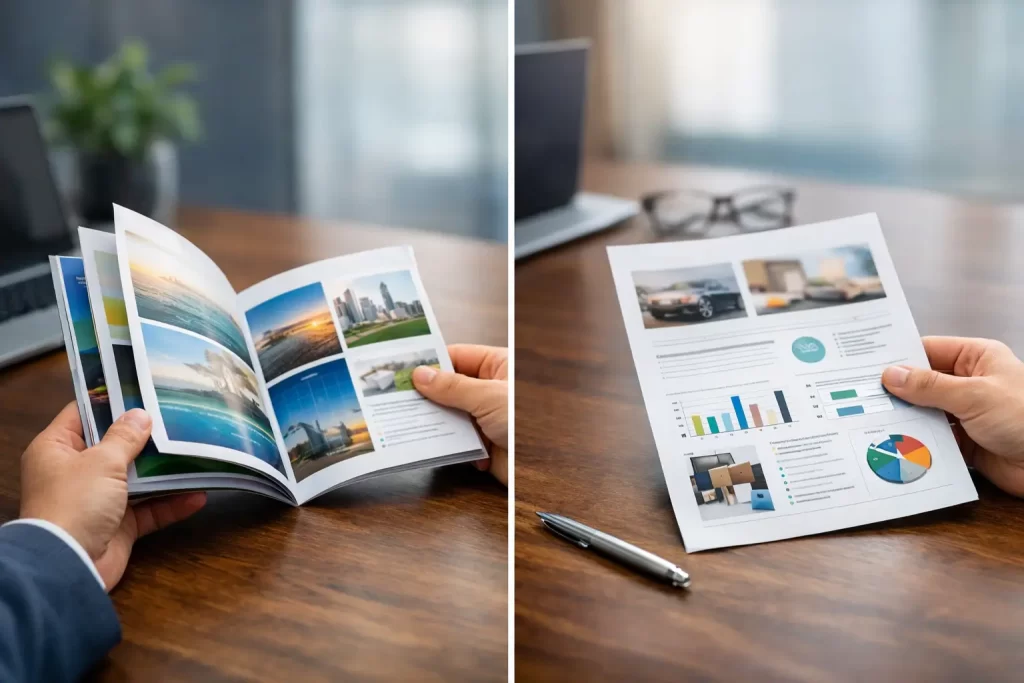
A company is heading to a trade show, launching a new service, or meeting with a major prospect, and the same question comes up every time: brochure vs sales sheet – which one actually makes more sense? The answer depends less on preference and more on what the piece needs to do. If you choose the wrong format, even strong design and good copy can feel unfocused.
Both pieces support sales and marketing, but they are built for different jobs. A brochure usually tells a broader brand story. A sales sheet is tighter, faster, and more specific. Knowing when to use each helps you avoid wasting budget, simplify your message, and give your audience something they will actually read.
Brochure vs sales sheet: the core difference
The simplest distinction is scope. A brochure is designed to present a business, program, service line, or product family in a more complete way. It gives you room to explain who you are, what you offer, what makes you different, and how people can take the next step. It often works well as a leave-behind piece, an introduction for new prospects, or a printed overview for meetings and events.
A sales sheet, sometimes called a sell sheet or one-sheet, is more focused. It is usually a single page and built around one offer, one product, one service, or one audience need. It gets to the point quickly. Instead of telling your entire story, it supports a specific conversation.
That difference matters because format shapes behavior. A brochure invites someone to browse. A sales sheet helps someone decide.
When a brochure is the better fit
A brochure makes sense when your audience needs context before they are ready to act. If your business has several services, multiple departments, a layered process, or a story that benefits from explanation, a brochure can organize that information without feeling abrupt.
This is often the right choice for professional service firms, healthcare practices, nonprofits, educational organizations, hospitality groups, and companies with a consultative sales process. A well-planned brochure can introduce the brand, explain capabilities, reinforce credibility, and provide enough detail to support follow-up conversations.
Brochures are also useful when presentation matters as much as information. At conferences, in welcome packets, inside proposal folders, or in reception areas, they help establish professionalism. Good brochure design creates a sense of structure and legitimacy that a simple one-page handout may not deliver.
That said, brochures can become too broad if the message is not disciplined. When everything feels equally important, the reader may leave without remembering much. More space is helpful only when the content is organized with purpose.
What a brochure does well
A brochure gives you room for brand positioning, service descriptions, process explanations, photography, testimonials, and supporting details. It can also carry design elements that reflect your visual identity more fully, which makes it a strong branding tool in addition to a sales tool.
In print, brochures work well as polished collateral pieces. In digital form, they can be offered as downloadable PDFs for prospects who want a clean overview. If accessibility matters for digital distribution, following guidance from the W3C Web Accessibility Initiative helps make documents easier for more users to read and navigate.
When a sales sheet is the better fit
A sales sheet is the better option when speed and clarity matter most. If a prospect is comparing options, reviewing a product line, or deciding whether to move to the next conversation, a concise one-page piece is often more effective than a multi-panel brochure.
Sales sheets are especially useful for manufacturers, software-related service providers, event venues, medical or wellness offerings, specialized business services, and any company that needs product-specific or audience-specific collateral. They are also practical for sales teams who need targeted materials for outreach, follow-ups, presentations, and campaign support.
Because a sales sheet is narrow in scope, it forces better prioritization. You have to decide what matters most: the problem, the solution, the features, the benefit, the proof, and the call to action. That discipline is often what makes it persuasive.
What a sales sheet does well
A strong sales sheet is easy to scan and easy to share. It can highlight one offer, one service package, one new product, or one vertical market. It often includes a short headline, a few benefit-driven sections, proof points, specs or deliverables, and a clear next step.
This format also updates more easily. If pricing, service details, dates, package inclusions, or technical information change often, replacing a one-page sheet is usually simpler than reworking a full brochure. That makes it a practical choice for businesses that need agility.
Design and messaging trade-offs
The brochure vs sales sheet decision is not just about size. It affects how your message is processed.
A brochure can feel more established and comprehensive, but it asks for more attention. If your audience is early in the buying process, that can be useful. If they are busy and just need the essentials, it may be too much.
A sales sheet is efficient and conversion-focused, but it does not leave much room for nuance. If your service requires education, trust-building, or explanation, a one-page format can feel too thin unless it is supported by your website, sales presentation, or additional materials.
That is why many businesses benefit from using both. A brochure supports the overall brand story. Sales sheets support individual offers, campaigns, or conversations. One is not automatically better than the other. They work best as part of a larger communications system.
How to choose the right format for your business
Start with the audience, not the format. Ask what they need to know at this stage. Are they learning who you are, or are they evaluating one solution? Do they need a broad overview, or are they making a specific decision?
Next, look at how the piece will be used. A brochure works well for trade shows, company overviews, onboarding packets, and proposal support. A sales sheet fits direct outreach, product highlights, sales meetings, digital attachment campaigns, and leave-behinds tied to a single service.
Then consider content stability. If your message changes often, a sales sheet may be the safer investment. If your core positioning is stable and your service set is established, a brochure can provide longer-term value.
It also helps to think about where the piece connects to your other marketing assets. Print collateral should not operate in isolation. The strongest materials align with your brand identity, website content, landing pages, and sales process. If the language on your printed piece does not match what prospects find online, trust can slip quickly. For broader brand alignment, businesses often benefit from coordinated branding, print design, web design, and SEO content rather than treating each item as a separate project.
If you distribute digital versions, file quality and formatting matter too. PDFs should be readable on desktop and mobile, sized appropriately for email sharing, and structured clearly. If the collateral supports online discovery, consistency with basic content quality guidance from Google Search Central can also help reinforce a more credible user experience across channels.
Common mistakes with brochures and sales sheets
The biggest mistake is trying to make one piece do everything. A brochure overloaded with product specs can become hard to scan. A sales sheet crammed with company history and too many service descriptions loses its edge.
Another common problem is weak hierarchy. Readers should be able to understand the message quickly through headings, subheads, imagery, and layout. If every section competes for attention, neither format works well.
Many businesses also underinvest in copy. Design matters, but so does language. Clear, specific, audience-focused writing is what turns a printed piece from decorative to useful.
And finally, collateral often fails when there is no next step. Whether it is a brochure or a sales sheet, the reader should know what to do next – call, email, book a meeting, request a quote, visit a service page, or ask for a proposal.
A practical way to decide
If you need to present the bigger picture of your business, choose a brochure. If you need to support a focused sales conversation, choose a sales sheet. If your business has multiple offerings and a longer decision cycle, there is a good chance you need both.
The most effective marketing materials are not chosen because they are standard. They are chosen because they match the audience, the message, and the moment. When the format fits the job, your content works harder, your sales process gets clearer, and your brand looks more organized from the very first impression.
If you are weighing brochure vs sales sheet, it usually means your business is ready for more intentional collateral. That is a good point to step back and make sure your print pieces, digital assets, and brand presentation are all telling the same story with the right level of detail.