A business website usually starts with a simple question that gets expensive fast: do you need a flexible platform your team can manage, or a fully tailored build created around specific goals? That is the real decision behind wordpress vs custom website, and the right answer depends less on trends and more on how your organization works, what your customers expect, and what you need the site to do over time.
For many businesses, this choice is not really about technology first. It is about control, speed, budget, branding, and long-term maintenance. A restaurant group may need menu updates and location pages handled in-house. A manufacturer may need a site that integrates with internal systems. A professional services firm may care most about credibility, lead generation, and search visibility. Each of those priorities can point to a different solution.
WordPress vs custom website: the real difference
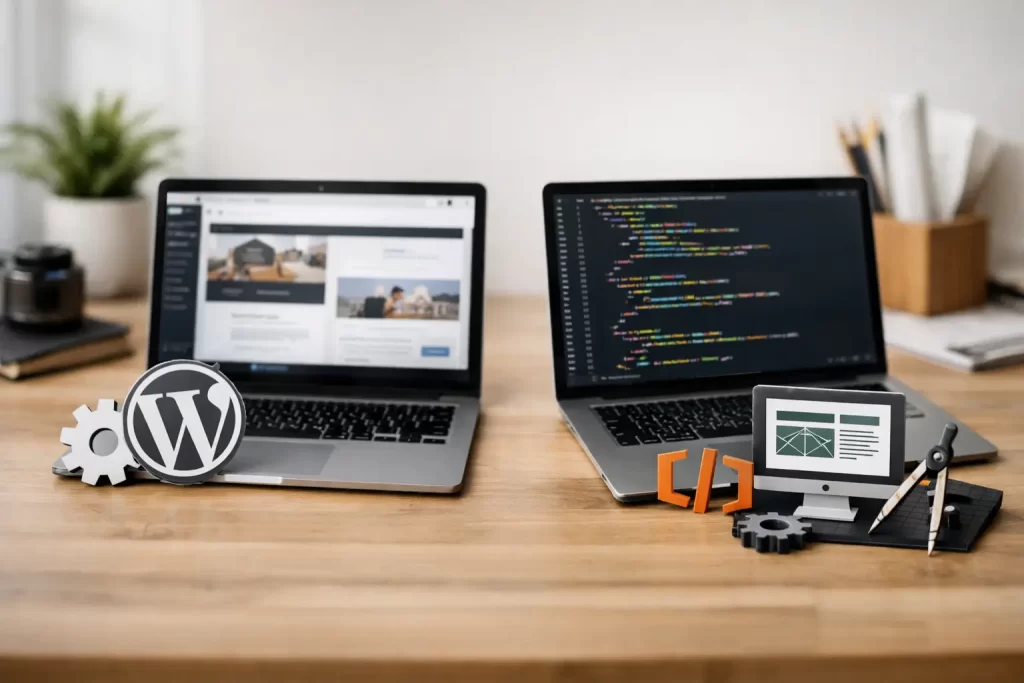
WordPress is a content management system with a large ecosystem of themes, plugins, and development options. It can support everything from a small brochure site to a fairly sophisticated marketing platform. A custom website, on the other hand, is usually designed and developed from the ground up around specific functional, visual, and operational requirements.
That distinction matters because these two paths solve different problems. WordPress often makes sense when a business needs a professional website that is editable, scalable, and cost-conscious without rebuilding common features from scratch. A custom website tends to make sense when the business has unusual functionality, complex integrations, specialized workflows, or very specific performance and governance requirements.
This is why the question is rarely which option is better in general. It is which option is better for the stage your business is in now, and what it is likely to need next.
When WordPress is the stronger business choice
WordPress remains popular for a reason. It gives businesses a mature framework for managing content, publishing new pages, improving search visibility, and expanding site features as marketing needs evolve. For many organizations, that is exactly the right balance of flexibility and practicality.
If your site needs service pages, team bios, case studies, blog content, landing pages, forms, galleries, and basic integrations, WordPress can usually handle that efficiently. It also gives non-technical teams a more manageable editing experience, which matters when updates need to happen regularly. A website that can be maintained is usually more valuable than one that looks impressive but depends on a developer for every change.
WordPress is also a strong fit when your website is part of a broader marketing system. If your business is investing in brand development, ongoing SEO content, digital campaigns, and routine site updates, the platform supports that workflow well. In many cases, a professionally built WordPress site can deliver the visual quality and strategic structure a business needs without the overhead of a fully custom build.
That said, WordPress only works well when it is planned and developed carefully. Too many plugins, bloated themes, and inconsistent maintenance can create security issues, slow load times, and editing headaches. The platform itself is not the problem. Poor implementation usually is.
When a custom website makes more sense
A custom website earns its value when your needs move beyond standard marketing-site functionality. If your business relies on proprietary tools, unusual data structures, advanced user roles, or system integrations that do not fit neatly into an existing platform, custom development can save time and frustration later.
This route is also worth considering when digital performance is tied directly to operations. For example, if users need to configure products, access protected resources in different permission levels, connect to third-party software, or complete actions that involve more than standard forms, custom architecture may provide a cleaner result.
Brand expression can also be a factor. While WordPress can absolutely support custom design, some organizations want a highly tailored front-end experience or a unique content model that would be awkward to force into a conventional CMS structure. In those cases, custom development gives more freedom, but it also requires stronger planning, documentation, and support.
A custom website is not automatically more impressive or more effective. It is simply more specific. That specificity can be valuable, but only when the business truly needs it.
Cost, timeline, and maintenance
For most organizations, the biggest practical difference in wordpress vs custom website is not visual. It is operational.
WordPress typically offers a faster path to launch and a more approachable cost structure, especially for marketing-focused sites. Because the core CMS already exists, development effort can focus on design, content structure, functionality, and optimization rather than reinventing foundational systems. That often means a shorter timeline and a lower total upfront investment.
Custom websites usually require more discovery, more technical planning, more development hours, and more testing. That is not wasteful if the site truly needs custom architecture. It simply means the budget must support a longer and more involved process.
Maintenance matters just as much as launch cost. WordPress needs regular updates, plugin oversight, backups, security monitoring, and occasional refinements. A custom website also needs maintenance, but the nature of that support depends on how it was built. In some cases, custom sites require a more specialized developer relationship, which can make ongoing changes slower or more expensive if the original build lacks documentation or flexibility.
This is one reason many businesses benefit from working with an agency that understands both design and long-term support. A website is not finished the day it launches. It becomes part of your marketing and communications infrastructure.
SEO, content, and growth potential
Businesses often assume custom means better SEO. That is not necessarily true.
Search visibility depends far more on site structure, page quality, content strategy, technical health, speed, mobile usability, and ongoing optimization than on whether the site is built in WordPress or coded from scratch. Google’s own documentation focuses on helpful content, crawlability, and usable site architecture, not on a preferred platform. WordPress can perform very well for SEO when it is built properly, and custom websites can perform poorly if those fundamentals are ignored.
What matters is whether your team can publish and improve content consistently. If your marketing strategy depends on adding service pages, location pages, articles, case studies, or campaign landing pages, WordPress often gives businesses a practical edge because content management is more accessible. Resources like WordPress.org and Web Content Accessibility Guidelines also reinforce the importance of maintainability and usable structure, not just design alone.
Growth should be part of the discussion too. A website that works for your business today may become limiting in two years. If you expect to expand services, add content regularly, support multiple departments, or connect the site to broader marketing efforts, choose the option that your team can realistically manage and develop over time.
How to decide between WordPress and custom development
The best decision usually comes from asking better business questions.
Start with what the website needs to accomplish in the next 12 to 24 months. Is it primarily a professional marketing presence designed to generate leads and support credibility? Does your team need to update content regularly? Will the site support SEO campaigns, blog publishing, or seasonal promotions? If so, WordPress is often the practical choice.
If the project involves specialized functionality, system integrations, advanced account features, or workflows that standard platforms do not handle well, custom development may be the smarter investment. Not because it sounds more advanced, but because trying to force highly specific requirements into the wrong platform can become more expensive than building correctly from the start.
It also helps to look honestly at internal capacity. A business that wants autonomy over content updates should not choose a system that only developers can comfortably manage. On the other hand, a business with complex digital operations should not limit itself just to keep the initial budget lower.
In many cases, the answer is not purely one or the other. A professionally designed WordPress site can include custom components, tailored templates, and strategic functionality without becoming a fully custom platform. That middle ground is often where the best value lives.
For organizations that need a site aligned with branding, search visibility, content strategy, and long-term maintenance, it helps to work with a partner who can connect those pieces rather than treat the website as an isolated project. Services such as web design, WordPress development, SEO, branding, print support, and ongoing marketing often work best when they are planned together.
A good website should fit the way your business operates now while leaving room to grow into what comes next. That is usually the clearest answer in the wordpress vs custom website debate.