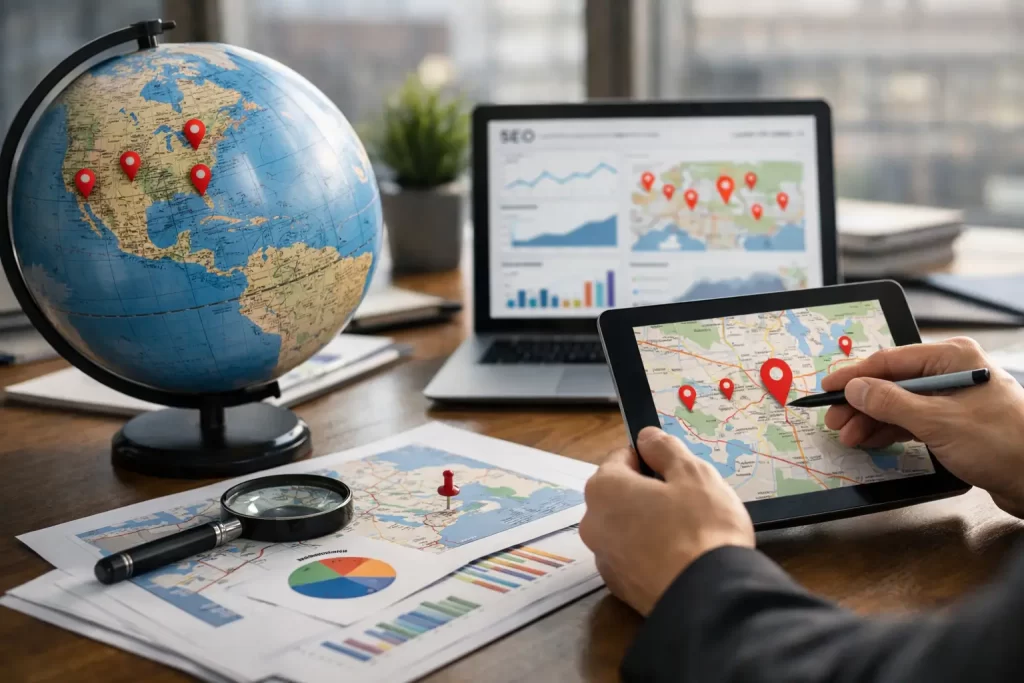
A search for “commercial HVAC maintenance in Phoenix” has a very different intent from a search for “commercial HVAC maintenance.” The first search signals a service need and a place. A practical guide to geo targeted SEO helps businesses show up with useful, credible information when those two needs meet.
For organizations that serve multiple cities, regions, or service areas, geo-targeted SEO is not about repeating town names across a website. It is about making it clear where you work, what you do there, and why prospective customers in that market should trust you. Done well, it supports qualified traffic, clearer customer journeys, and a website that reflects the real scope of your business.
What Geo Targeted SEO Actually Means
Geo-targeted SEO is the practice of improving a website’s relevance for searches connected to a specific geographic area. That area may be a neighborhood, city, county, metro area, state, or broader service region. The right level depends on how customers search and how the business operates.
A restaurant with one physical location should focus on its immediate market. A regional manufacturer may need pages and content that speak to several states. A professional service firm with national clients may benefit from market-specific content only where it has a meaningful presence, dedicated team, or established service offering.
Search engines use many signals to understand location relevance. Website content is one part of the picture. Business information, service pages, structured page organization, customer reviews, local references, and the consistency of your brand across channels all contribute to the larger impression.
The goal is not to persuade a search engine that your business is everywhere. The goal is to give people accurate, useful answers in the places you genuinely serve.
Start With Your Actual Service Footprint
Before creating pages, define the geography your business can support operationally. This sounds basic, but it prevents one of the most common SEO problems: publishing location pages for markets where the company has little to say and no practical ability to serve customers.
Begin with three questions. Where do you have a physical office, storefront, or facility? Which markets do you actively serve without adding friction for customers? And where is there enough demand to justify targeted content, sales support, or advertising?
A service-area business may reasonably organize its site around a primary market and several surrounding communities. A business with offices in several states can create location pages for each office, supported by local contact details, staff information, directions, and service descriptions. A national company may need a different approach, using industry, service, or regional content rather than thin city pages.
Accuracy matters. If a location page promises fast on-site service in a city two hours outside your normal travel range, it may generate inquiries that disappoint both the prospect and your team. Strong marketing begins with a clear representation of the business.
Build Location Pages That Deserve to Exist
A location page should answer the questions a customer in that market would naturally have. What services are available here? Which types of clients do you serve? Is there a local office or a defined service area? How can someone contact you? What experience, work examples, or process details make the page useful?
The best pages use location as context, not decoration. For example, a commercial contractor’s page for a growing metro area might discuss the project types it handles there, the industries it serves, its service radius, and its approach to scheduling. A healthcare practice may explain which services are offered at a particular office, how to prepare for an appointment, and which nearby communities it serves.
Each page should have its own purpose and original substance. Avoid making one generic page and changing only the city name. That approach creates a poor reading experience, weakens brand credibility, and may make it harder for search engines to see meaningful differences between pages.
Useful elements can include:
- A clear description of the services available in that location or service area
- Accurate address, phone, hours, and contact information when there is a physical location
- Details about the local team, facility, service process, or market-specific capabilities
- Relevant project examples, testimonials, photos, or frequently asked customer questions
- A direct next step, such as requesting an estimate, scheduling a consultation, or calling the appropriate office
Not every business needs a page for every nearby city. If the content cannot be distinct and helpful, a well-developed regional page is often the better choice.
Use Page Structure to Clarify Geographic Relevance
A geo-targeted page should be easy for a person to scan and easy for a search engine to understand. That starts with a descriptive page title, a clear main heading, and body copy that explains the relationship between the service and the place.
For instance, “Commercial Landscaping Services in Raleigh, NC” is clearer than “Raleigh Page.” The first phrasing identifies the service, the market, and the page’s purpose. The same principle applies to image descriptions, navigation labels, and internal page organization.
Location pages should also connect naturally to related services. A visitor who reaches a page about a specific office should be able to find the services offered there, the company’s broader credentials, and a clear contact path without hunting through the site.
For businesses with several markets, consistent templates are useful for maintaining visual quality and brand standards. Consistency should not mean identical copy. A professionally designed website can provide the shared structure while leaving room for genuine local information, market-specific photography, and tailored calls to action.
Strengthen the Signals Beyond Your Website
Your website is the center of your digital presence, but geo-targeted SEO works best when other public-facing information agrees with it. Inconsistent business details create confusion for customers and make it harder to present a reliable brand.
Review your company name, address, phone number, hours, and website information wherever customers may encounter it. This is especially important for businesses with multiple locations, relocated offices, or separate departments handling marketing and customer service.
If your company has a physical location, maintain an accurate business profile in major search platforms and respond to customer reviews with professionalism. Reviews are not simply a ranking tactic. They are public evidence of how a business communicates, resolves concerns, and values its customers.
Local involvement can also create authentic relevance when it is part of your business. Sponsorships, community partnerships, trade associations, local events, and educational resources may give a company meaningful material to share. The point is not to manufacture local signals. It is to document legitimate connections to the markets you serve.
Create Content Around Local Customer Needs
Location pages are only one piece of the strategy. Ongoing content can help a business address questions that arise in particular markets, industries, or seasons.
A property management company could publish guidance on preparing commercial buildings for regional weather patterns. A manufacturer might explain shipping considerations or capabilities for customers in a specific service region. A nonprofit may create event or program pages that clearly identify the communities they support.
This content should begin with a real customer question. A city name alone does not make an article valuable. Consider what varies by location: regulations, climate, service availability, common project types, travel logistics, local demand, or customer priorities. If nothing meaningfully varies, broader educational content may be more useful than forcing a geographic angle.
The same standard applies to visual assets. Original project photography, staff images, maps, branded print materials, and local campaign creative can make a page feel more credible and complete. Design, content, and SEO should support one another rather than operate as separate tasks.
Measure Quality, Not Just Rankings
Rankings matter, but they are not the only evidence that geo-targeted SEO is working. Watch for growth in qualified organic visits, completed contact forms, phone inquiries, direction requests, and leads from the markets that matter most to the business.
It is also worth reviewing what happens after visitors arrive. If a location page attracts traffic but has a high exit rate and few inquiries, the issue may be page relevance, unclear service details, a weak call to action, or a mismatch between the search query and the page content. Better SEO often requires better communication, not more keywords.
Give changes time to take effect, particularly in competitive markets. Search visibility develops through consistent information, useful content, sound site structure, and an established record of serving customers well. Short-term tactics may produce activity, but durable results depend on pages that remain accurate and valuable.
When a Broader Strategy Is Better
Geo-targeted SEO is not the answer for every business goal. A company selling specialized products nationwide may gain more from product-category pages, case studies, and industry-focused content than from dozens of city pages. Likewise, a consulting firm serving clients remotely may need to emphasize expertise and sector knowledge before geographic coverage.
The right approach depends on how people find you, how they make purchasing decisions, and what your team can deliver. For many businesses, the strongest plan combines a polished website, focused service pages, accurate business information, search-friendly content, and marketing materials that present the same professional message across every touchpoint.
Toucan Design helps organizations bring those pieces together through website design, branding, content, and SEO work built around real business priorities. Start with the markets you can serve well, create pages that genuinely help customers there, and let every detail reinforce the confidence people need before they contact you.